Wind Power Continuity
Capture curtailed wind energy to ensure uninterrupted power supply
Overview
Storing Curtailed Wind Power for Continuous Supply
Korea is becoming a leading offshore wind power country with 2 GW offshore wind power purchase planned for December 2025. IsoTES® serves as ESS for offshore wind, storing curtailed power as heat and converting it back to electricity to guarantee minimum power supply.
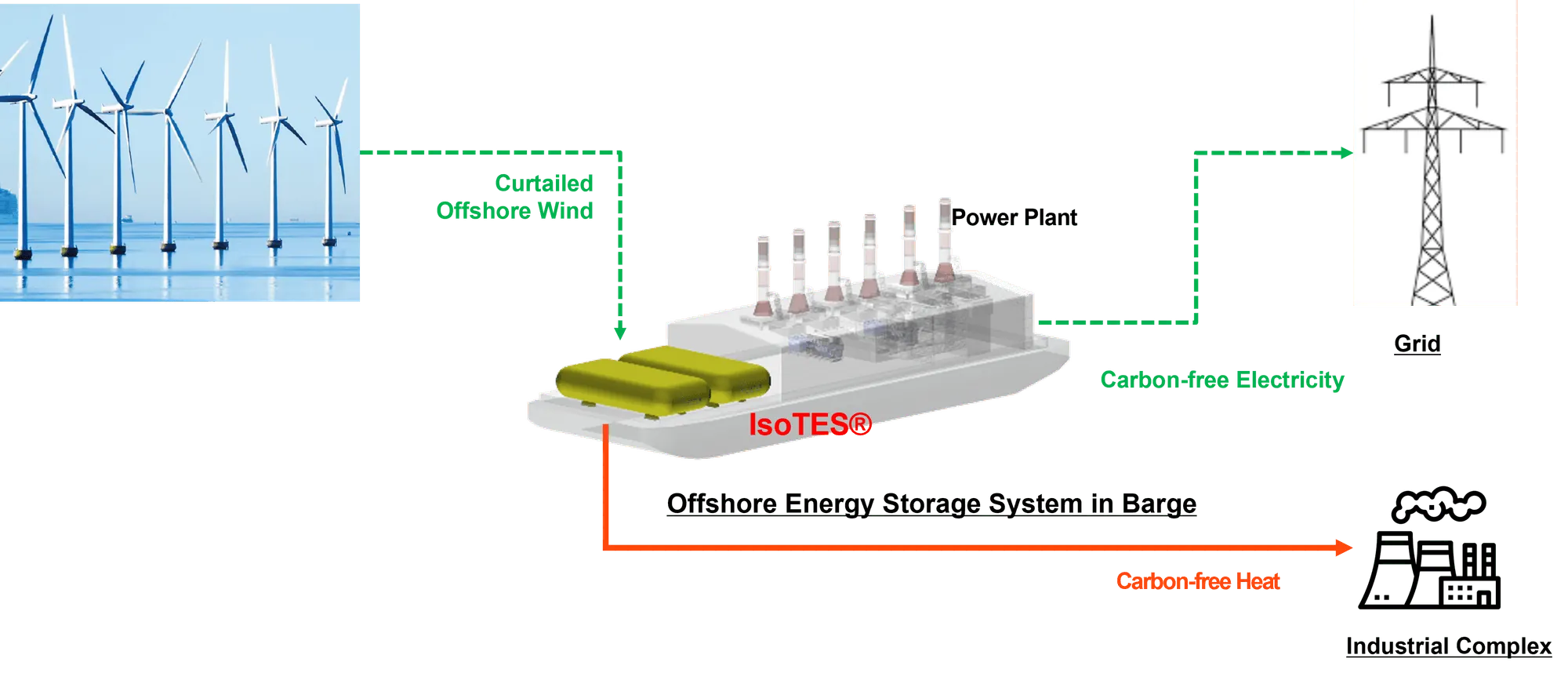
Offshore wind power storage concept with IsoTES®
Background & Challenges
Background
Korea is becoming a leading offshore wind power country
- Korea has nominated suppliers for 2 GW offshore wind power purchase in December 2025
- Offshore wind is one of the key renewable energy sources with varying output
Challenges
Offshore wind power faces key challenges
- How to guarantee minimum wind power supply
- How to handle curtailed wind power when supply exceeds demand
Solution and Values delivered by IsoTES®
-
IsoTES® can be the ESS for offshore wind
-
IsoTES® stores curtailed wind power in the form of heat and converts it to electricity
-
This guarantees the minimum power supply from wind farms
-
The IsoTES® is huge in size for this application - a 10 GWh system needs about 60,000 m³ thermal storage tanks
-
We are thinking about installing IsoTES® on used ships (e.g., 100K oil tanker)
How It Works
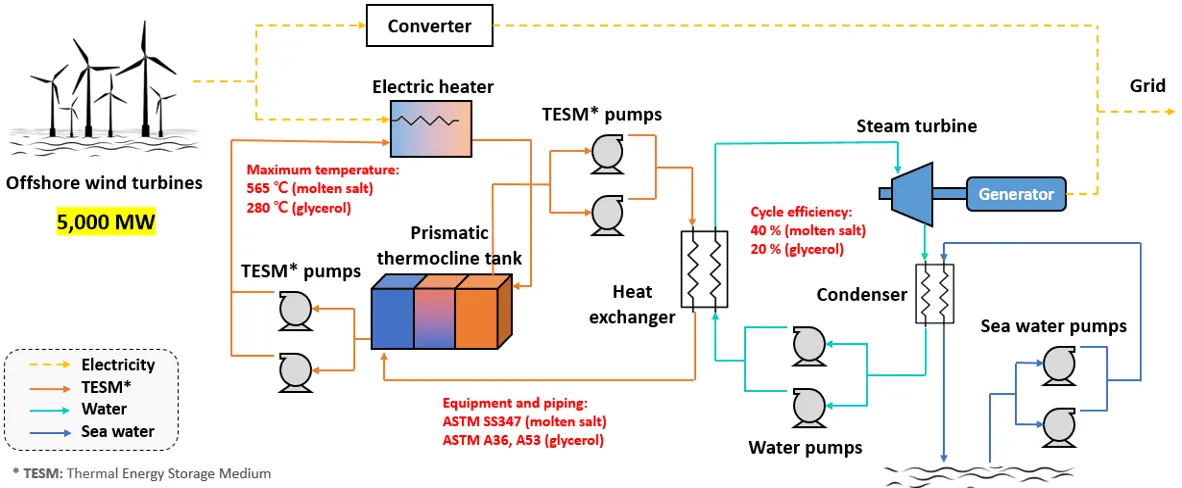
Process flow diagram of the conceptual design: Offshore wind turbines → Electric heater → Prismatic thermocline tank → Steam turbine → Grid
Key Values
Features and benefits of this solution
Key Features
- Power-to-heat conversion at scale (5,000 MW offshore wind turbines)
- Prismatic thermocline tank with electric heater
- Steam turbine generator for electricity output
- Can be installed on used ships (e.g., 100K oil tanker for 10 GWh)
Benefits
- Guarantee minimum wind power supply
- Store and utilize curtailed wind power
- Grid-scale energy storage solution
- Lower LCOS with glycerin-based TESM
Comparison of Molten Salt and Glycerin-based System
Evaluating thermal energy storage medium options
| Property |
🧪
Glycerin
|
🔥
Molten Salt
|
|---|---|---|
| Storage Temperature | 280°C (Lower) | 565°C (Higher) |
| Carnot Efficiency | 20% (Lower) | 40% (Higher) |
| Storage Tank Size | Bigger | Smaller |
| Tank Material Cost | Cheaper (Lower CAPEX) | More expensive |
| State at Room Temp | Liquid (No solidification risk) | Solidifies (Requires heat tracing) |
| Solidification Risk | None | Pugging, thermal expansion damage |
| Maintenance | Easier | More complex |
| LCOS Difference | Comparable | Comparable |
Glycerin is better in terms of solidification-induced risk and cost, with insignificant difference in LCOS between the two options.
Technical Highlights
Engineering details and specifications
Maximum temperature: 565°C (molten salt) / 280°C (glycerin)
Cycle efficiency: 40% (molten salt) / 20% (glycerin)
Equipment: ASTM SS347 (molten salt) / ASTM A36, A53 (glycerin)
Status & Plan
GIGAette and KAIST have conducted a feasibility study comparing two TESM options: Glycerin and Molten salts
Though glycerin delivers lower temperature heat, it is regarded as better TESM considering the LCOS and solidification risk
Glycerin is liquid at room temperature while molten salt solidifies, avoiding costly heat tracing systems
Related Technology
Learn more about the IsoTES® systems used in this application
Related Applications
Explore more applications in this category
Coal Plant to Grid Storage
Transform retired coal plants into grid-scale thermal energy storage facilities
Ready to Get Started?
Let us help you implement Wind Power Continuity with IsoTES® technology.