With energy costs and pressure to cut emissions both rising, food factories are looking for places to save energy. But where should they start?
The answer is simpler than it seems. More than half of the energy a food factory uses goes into heat, and most of that heat is steam made in a boiler. This post looks at where food factories use steam, and sets out ways to cut the energy it takes, easiest first.
Half of a food factory’s energy is heat
According to a study of the French agri-food industry, more than half of the sector’s energy goes into producing heat. That heat goes into four main places.
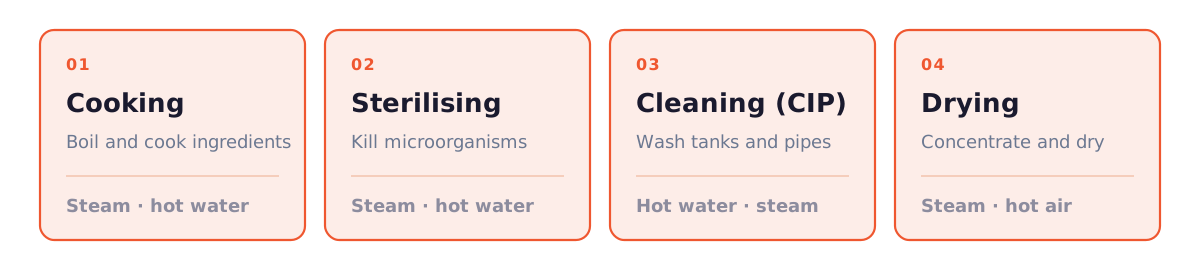
Most plants make steam in one boiler house and pipe it around the site. Steam carries far more heat than the same weight of hot water, and setting its pressure sets the temperature it heats to. That is why it is so widely used to move heat around food factories.
The heat is not very hot. The same study finds that about 75% of the heat required is below 150°C, and around half is below 100°C. That matters when choosing how to save energy, as the steps below show.
Step 1: Stop heat from leaking
The first job is to keep the steam you have already made from leaking away.
- Insulate pipes: Bare steam pipes give off heat constantly. The U.S. Department of Energy says insulation can typically cut that loss by about 90%. Any surface above about 49°C should be insulated, from boiler surfaces and piping to fittings such as valves. Insulation removed during repairs and never replaced is worth checking too.
- Return condensate: Condensate, the water left after steam gives up its heat, is still hot. The energy left in it can be more than 10% of the steam’s total energy. Sending it back to the boiler instead of down the drain cuts the fuel, water and treatment chemicals needed to heat cold make-up water.
Step 2: Reuse heat that is thrown away
Next comes putting heat that is lost inside the plant back to work.
- Recover exhaust heat: Air leaving a food dryer is still around 90°C. Using it to preheat the air going into the dryer can cut the dryer’s energy bill by 4–5%, according to one analysis.
- Heat pumps: Because most food process heat is not very hot, heat pumps, which lift low-grade waste heat to a useful temperature, are a good fit. The International Energy Agency estimates that heat pumps could meet 40% of the agri-food industry’s heat demand.
Step 3: Change how the heat is made
The last step is to change how the heat is made, moving away from boilers that burn fuel.
Because food process heat is not very hot, it can just as well come from renewable electricity or waste heat. Plants differ, but where processes such as sterilising or cleaning run at set times, heat demand can swing through the day. That is why thermal storage, which makes heat when electricity is cheap or waste heat is available and holds it until it is needed, is also being considered.
The bottom line
Saving energy in a food factory starts with steam. Stop heat from leaking, reuse heat that is thrown away, then change how the heat is made: the steps can be taken in that order. The starting point is to find out which step your plant is at today.
If you would like to look at where your plant’s steam use could be cut, request a technical meeting.
Sources
- Electrifying low-temperature heat in the Food and Beverage industry in France — Carbone 4 (15 May 2025) — more than half of agri-food energy use goes into heat; about 75% of process heat below 150°C and about 50% below 100°C; citing the IEA, heat pumps could meet 40% of agri-food heat demand
- What is Steam? — Spirax Sarco — steam holds far more heat per unit mass than water; saturated steam temperature is set by pressure
- Insulate Steam Distribution and Condensate Return Lines (Steam Tip Sheet #2) — U.S. Department of Energy (January 2012) — insulation typically reduces energy losses by 90%; insulate any surface over 120°F, including boiler surfaces, piping and fittings
- Return Condensate to the Boiler (Steam Tip Sheet #8) — U.S. Department of Energy (January 2012) — energy in condensate can exceed 10% of total steam energy; returning it saves fuel, make-up water and treatment costs
- Ways to reduce energy for spray drying — IP&D experts, report for the Netherlands Enterprise Agency (RVO) (29 May 2022) — dryer outlet air at 90–95°C; using it to preheat inlet air saves 4–5% on the energy bill
- Cover photo: Elevate / Unsplash (colour-adjusted)