Step down onto an Underground platform in winter and it feels far warmer than the street. Trains, station equipment and passengers give off heat all the time, and to stop it building up in the tunnels it escapes to the surface through ventilation shafts beside the stations.
In London, Islington Council is using that discarded heat to warm local flats and a school.
How Tube waste heat reaches people’s homes
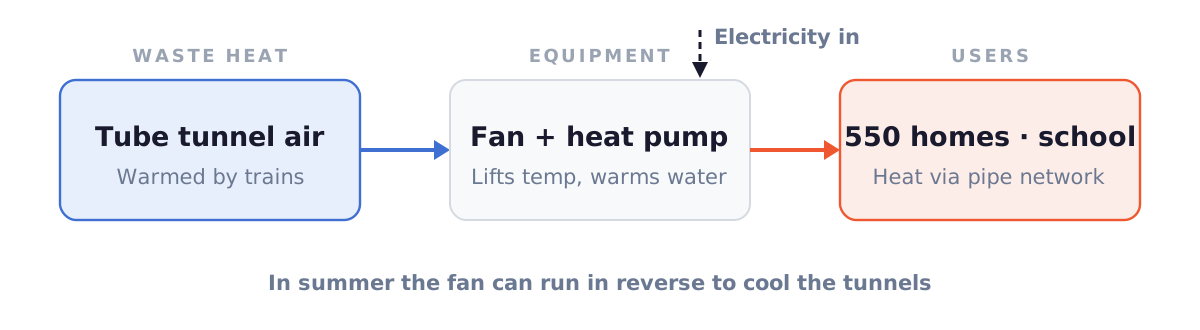
Tunnel air is warm, but not warm enough to heat homes directly. So once the shaft fan draws it up, a heat pump uses electricity to make that lukewarm heat hot enough for heating, and uses it to warm water. The hot water then travels through insulated pipes to the surrounding flats and school.
For other ways to put waste heat to use besides heat pumps, see:
Bunhill in numbers
| Item | Detail |
|---|---|
| Location | Bunhill, London Borough of Islington, UK |
| Heat source | Warm air from Northern line tunnels |
| Distinction | World’s first use of Tube waste heat for district heating (per the council) |
| Newly connected | 550 homes, 1 primary school |
| Existing network (since 2012) | About 800 homes, 2 leisure centres |
| CO₂ reduction | About 500 tonnes a year (phase 2) |
| Heating bills | 10% discount for council tenants |
| Opened | March 2020 |
Cooler Tube tunnels in summer
The shaft fan at Bunhill can also run in reverse in summer to cool the Underground tunnels. In winter the discarded heat warms the neighbourhood; in summer the hot tunnels are cooled so passengers travel in less heat.
What this case shows
Bunhill shows that waste heat does not only come from factory chimneys. Low-grade heat quietly escaping all over a city, like the air from a Tube ventilation shaft, can heat homes once a heat pump lifts its temperature.
The council believes the same approach could work at other London shafts and in other cities with underground railways, and could be applied to other urban heat sources such as data centres.
The bottom line
Bunhill heats 550 homes and a school with warm air the Underground used to throw away. It shows, close to everyday life, that heat too cool to seem useful becomes useful once it is connected to where it is needed.
GIGAette’s IsoTES® is a constant-temperature thermal energy storage system that holds recovered heat like this until it is needed.
If you would like to look at where the heat leaving your own site could be used, request a technical meeting.
Sources
- Bunhill Heat and Power Network — Islington Council (2021) — world’s first heat network using Underground waste heat; phase 1 (since 2012) about 800 homes and two leisure centres; phase 2 adds 550 homes and a primary school; about 500 t of CO₂ saved a year; 10% heating discount for council tenants; fan reversible in summer to cool the tunnels; the two energy centres back each other up
- Waste heat from London Underground begins warming capital’s homes — Dezeen — opened in 2020; energy centre on the former City Road station site
- Bunhill 2 Energy Centre — JCT — fan draws warm air from the Northern line tunnels for the heat pump
- Cover photo: Pau Casals / Unsplash