Spray drying turns liquids into powder, and it is one of the most heat-hungry processes in a food factory. Why does it use so much energy, and how can that be cut? The key is that evaporating water takes a great deal of heat, so the most effective savings start before the product reaches the dryer.
How a spray dryer works
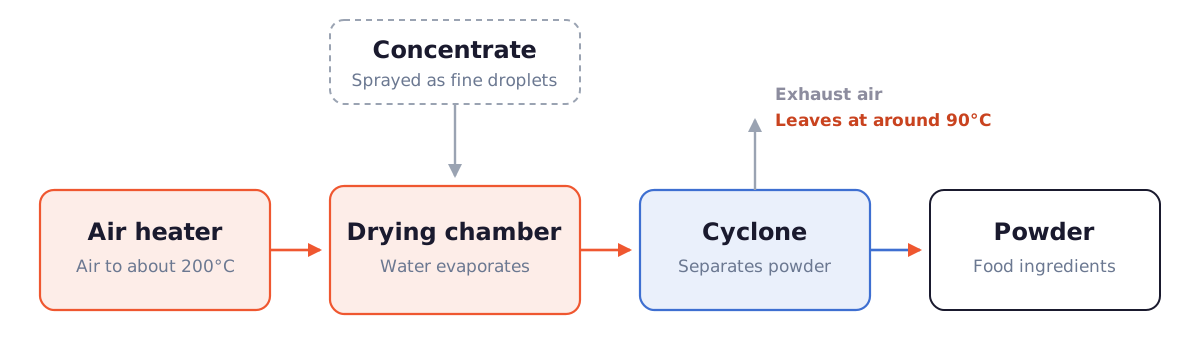
A spray dryer sprays concentrated liquid as fine droplets and dries them almost instantly in hot air. It is widely used to make powdered ingredients such as dairy and protein powders.
Why spray drying uses so much heat
To make powder, the water in the liquid has to be removed, and spray drying uses 10–20 times more heat than an evaporator to remove the same amount. An evaporator can only make the liquid more concentrated, though, not turn it into powder, so plants concentrate as far as they can in the evaporator and use spray drying only for the final step.
On top of that, the moist exhaust air leaves at around 90°C, still hot, carrying part of the heat away with it.
Ways to cut spray drying energy
| Measure | What it involves | Saving |
|---|---|---|
| Concentrate further | Remove more water in the evaporator before the dryer | About a third, raising solids from 30% to 40% |
| Dehumidify the air | Keep the inlet air at a constant humidity all year | Roughly 14% a year |
| Widen the temperature gap | Lower the outlet air temperature slightly | About 9%, from 90°C to 80°C at the outlet |
| Preheat the feed | Heat the feed outside the dryer | Roughly 2–5% |
| Clean less often | Group runs of the same product to cut changeover cleaning | Energy for cleaning and restarting |
The biggest gains come from removing water before the dryer. Temperatures should only be adjusted within the range where the product does not stick, and cleaning only within hygiene requirements.
How dryer heat is changing
Most dryer air is still heated with gas, but electric heating is spreading fast. Because electricity prices vary through the day, making heat in advance and storing it for when the dryer runs, using cheap electricity or spare waste heat, is also being considered.
The bottom line
Spray drying energy should be cut not only inside the dryer but before the product reaches it. Savings start with removing water from the feed first and keeping the air conditions steady.
GIGAette’s IsoTES® is a constant-temperature thermal energy storage system that holds heat made from waste heat or renewable electricity and releases it at the same temperature when it is needed.
If you would like to look at how to cut heat use in your drying process, request a technical meeting.
Sources
- Ways to reduce energy for spray drying — IP&D experts, report for the Netherlands Enterprise Agency (RVO) (29 May 2022) — how spray drying works and what it is used for; heat use versus evaporators (6-stage evaporator about 430 kJ, spray drying up to 6,000 kJ per kg of water); outlet air at 90–95°C; savings from concentration, dehumidification, temperature gap, feed preheating and cleaning; gas heating and electric heaters
- More efficient milk powder production through evaporation to very high solids content — Chalmers University of Technology, funded by the Swedish Energy Agency (2013–2014) — spray drying is 10–20 times more energy intensive than evaporation
- Cover photo: Elevate / Unsplash (colour-adjusted)