The previous post looked at six common ways factories use waste heat. All six shared one thing: waste heat has to be used the moment it comes out, and if nothing needs it then, it is simply lost.

Most waste heat is lost to timing
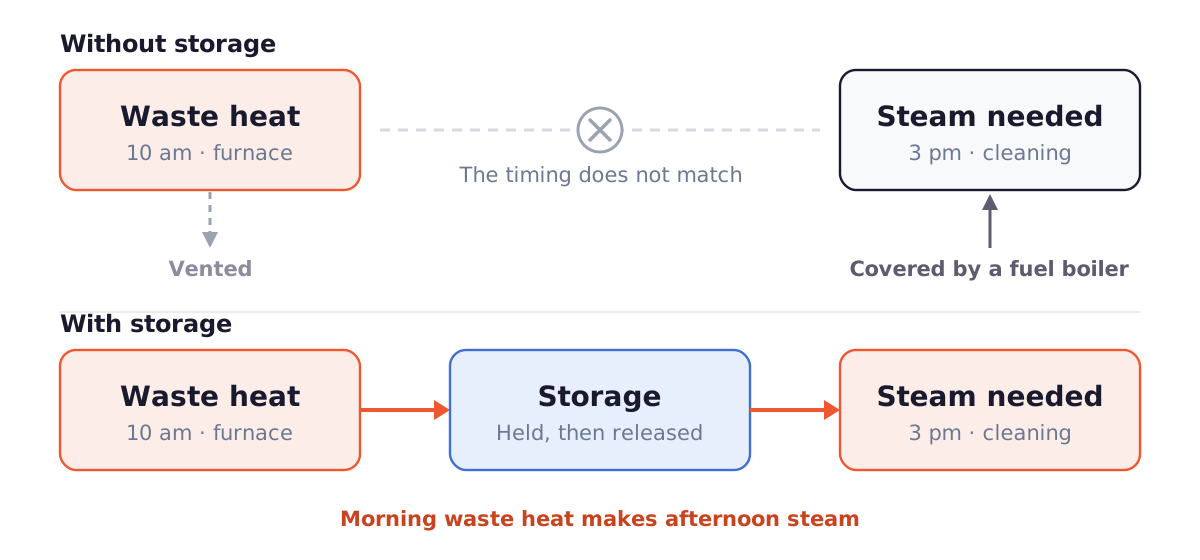
Say a furnace releases waste heat in the morning, but steam is needed for cleaning in the afternoon. With the timing out of step, the morning heat is vented and the afternoon steam has to come from a fuel-fired boiler.
There are two broad ways to close that gap: match the user and the timing, or hold the heat for later.
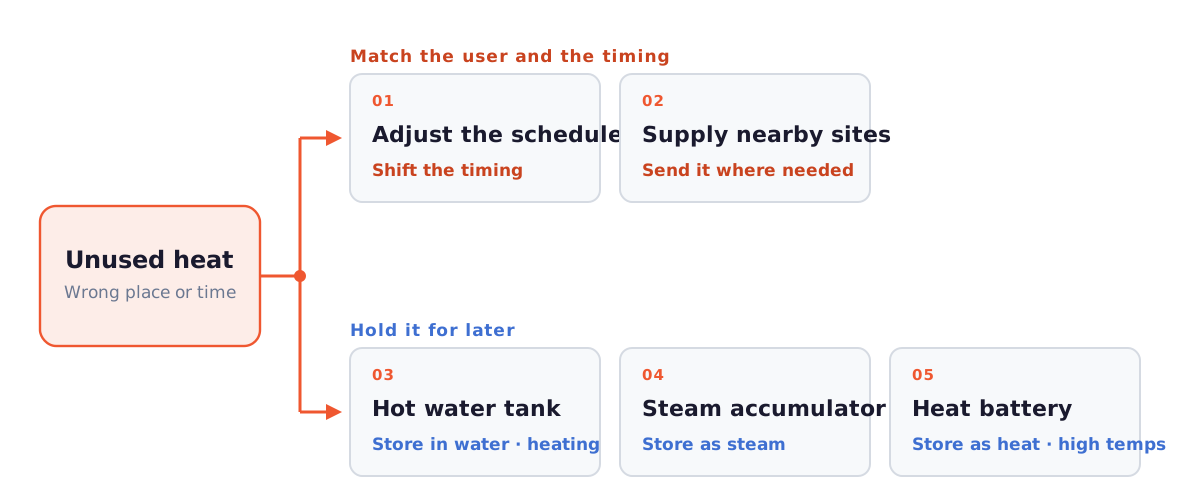
① Adjust the schedule — shift when the heat comes out
Line up the running hours of the process that releases waste heat and the process that uses heat. Its biggest advantage is that no new equipment is needed. But it means moving the wider production plan, and delivery dates or staffing do not always allow it.
② Supply nearby sites — send it where it is needed
This puts the direct supply from the previous post to work when the timing is off. If nothing on site needs the heat right now, it goes to another plant or a district heating network that needs heat at that time. In Kalundborg, Denmark, companies in the same area have exchanged water, energy and materials since 1972. It does require a user close by, and laying pipes and agreeing contracts takes time.
③ Hot water tank — store it in water
Water is heated and held in a large tank, then drawn on when needed. It is simple, water is cheap, and the approach is long proven — but at atmospheric pressure water cannot exceed 100°C, so it mainly suits lower-temperature uses such as space heating and hot water.
④ Steam accumulator — store it as steam
Hot water is held under pressure in a vessel, and steam is released by lowering the pressure. In use since the 1930s, it can feed steam straight to a process. As steam is drawn off, though, the pressure inside the vessel drops, and so does the pressure of the steam that comes out.
⑤ Heat battery — store it as heat
Waste heat is held in a storage medium, and when it is needed that heat makes steam or hot air. It can reach higher temperatures than water, so it can also serve high-temperature processes. Depending on how it stores heat, though, the output temperature may fall as it discharges — worth checking if the process needs a steady temperature.
Which one fits your plant?
Three questions narrow the options.
- Can the production schedule change? If so, ① solves it without new equipment.
- Is there a nearby user that needs heat at the same time? If so, ② is worth considering.
- What temperature is the heat needed at? If neither of the first two works, choose storage: ③ for space heating or hot water, ④ or ⑤ for steam, and ⑤ for higher temperatures.
The bottom line
Waste heat that cannot be used right away does not have to be thrown away. Match the user and the timing, or hold it for later. Which route fits depends on the plant’s schedule, nearby sites and the temperature of the heat it needs.
GIGAette’s IsoTES® is a constant-temperature thermal storage system for the storage route, designed to keep a steady output temperature while the stored heat is drawn on.
If you would like to work out which approach suits your plant’s waste heat, request a technical meeting.
Sources
- Kalundborg Symbiosis — official site — industrial symbiosis since 1972, with partner companies exchanging water, energy and materials
- Steam accumulator comprising a latent heat accumulator and a steam thermocompressor — US Patent 10190443 — Ruths-type steam accumulators are sliding-pressure stores whose pressure falls during discharge
- Chemical Engineering Transactions Vol. 70 (2018), p.357 — AIDIC — Ruths steam accumulators in use since the 1930s
- Cover photo: Mikhail Ilin / Unsplash (colour-adjusted)