Beer is served cold, but making it is mostly hot work. A brewery outside Lisbon, Portugal, has long burned natural gas to produce that heat. It is now preparing to raise that same steam with solar power and a heat battery instead.

Photo: engin akyurt / Unsplash
The heat inside a glass of beer
Most of a brewery’s heat goes into pasteurising and cleaning. Finished beer has to be pasteurised to secure shelf life and consistency, and cleaning the fermentation and storage vessels in place — tens of thousands of litres each — calls for a steady supply of hot water and thermal energy. That is why steam demand at a large brewery is substantial, and it converts directly into fuel cost and carbon emissions.
CIP (Clean-in-Place) circulates cleaning solution through pipework and vessels without dismantling them. It saves the teardown, but heating and circulating that solution still takes energy.
So when a brewery starts looking at decarbonisation, solar is the first answer that comes up.
Why solar alone falls short
That is especially true in a sunny country like Portugal. But there is a decisive obstacle.
The sun shines during the day; the brewery needs steam 24 hours a day.
If generation stops after dark or under cloud cover, the production line can stall. Solar can only replace the gas boiler if the electricity made at midday can be stored as heat and drawn back out the moment steam is needed. That is what a heat battery does.
Pairing solar with a heat battery
Heat battery specialist Rondo Energy, Portuguese energy group EDP, and Heineken’s local operation, Sociedade Central de Cervejas, built the answer together.
The design is straightforward. Electricity from a new 7MW on-site solar plant and a long-term renewable power contract heats Rondo’s refractory brick stack to very high temperature. When steam is needed, that stored heat is drawn back out to raise it. In effect, heat made when power is cheap is moved to the hour the process needs it.
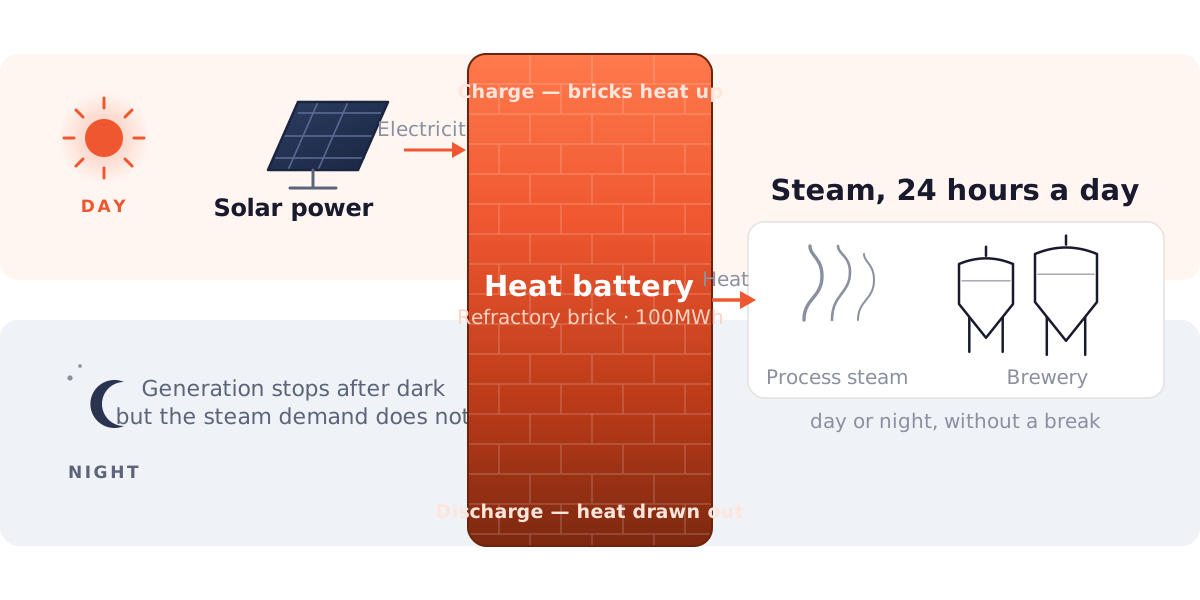
The heat battery going into the Vialonga brewery near Lisbon is rated at 100MWh and is targeted to start up in April 2027. It is among the largest heat battery projects in the beverage industry, and forms part of a European Investment Bank–backed push to scale heat battery deployment across Europe.
What actually changes
So what changes from the brewery’s point of view? The biggest shift is the energy source. Where natural gas was burned to raise steam, stored heat from renewable electricity takes its place.
| Aspect | Gas boiler (conventional) | Solar + heat battery |
|---|---|---|
| Energy source | Natural gas | Renewable electricity |
| How heat is raised | Burning gas to make steam | Stored heat drawn back out as steam |
| Round-the-clock supply | Yes | Yes, via stored heat |
| Carbon emissions | Direct emissions from combustion | No direct emissions in operation |
| Process changes | — | Same steam format, existing equipment reused |
The row that matters most is the steam itself: it arrives in the same form the process already uses. The plant changes its fuel without redesigning its production line.
Why this case matters
A brewery that has raised its steam by burning gas is preparing to run on sunlight and stored heat. That is more than one plant’s cost-saving exercise — it shows how industrial process heat, long treated as the blind spot of decarbonisation, can change.
What the project demonstrates is simple enough. What an industrial site needs is not electricity as such, but heat at the right temperature at the moment the process calls for it.
GIGAette’s IsoTES® is aimed at the same problem: a constant-temperature storage system that holds a steady output temperature throughout discharge, so heat arrives on the terms the process actually requires.
For background on why industrial process heat is so hard to decarbonise, see the companion piece below.
Sources