Say “battery” and most people picture the lithium-ion cell in a phone or an electric car — a device that holds electricity until you need it.
But the energy an industrial site actually consumes is far more often heat than electricity. A large share of a factory’s energy budget goes to steam and high-temperature process heat. A heat battery holds that heat directly and releases it on demand. The engineering term is Thermal Energy Storage (TES).
One name, but not one method. How the heat goes in determines how it behaves coming out.
What a Heat Battery Actually Stores
The distinction from an electrochemical battery is simple: one stores electricity, the other stores heat.
What matters is the form you get back. If a plant needs heat, storing electricity and converting it back to heat costs you a conversion loss. Storing heat as heat avoids that step entirely. The storage media are also ordinary materials — water, rock, salt — which changes the economics of large, long-duration storage.
We compared the two technologies head-to-head here:
1. Sensible Storage — Raise the Temperature
The most basic approach. Heat a material, hold it, then recover the heat as the material cools. Water, rock, sand, refractory brick, concrete, and molten salt all serve as media.
It works the way a thermos does. The construction is simple and the materials are cheap, which is why sensible storage accounts for most industrial-scale deployments today.
It also carries an unavoidable trait: the temperature falls as you draw heat out. The output starts hot and grows progressively cooler. For preheating or drying, where a sliding temperature is acceptable, that is fine. For a process that has to hold a set point, it becomes a real constraint.
2. Latent Storage — Use the Change of Phase
This method uses the heat a material absorbs or releases when it changes state — solid to liquid, liquid to gas. Such materials are called Phase Change Materials (PCM).
It is the same physics as ice pulling heat from a drink. And it produces one useful property: the temperature barely moves while the phase change is underway. Ice water sits at 0°C until the last of the ice melts.
That property lets latent storage deliver heat at a near-constant temperature throughout discharge. It also packs more energy into the same volume than sensible storage does.
3. Thermochemical Storage — Hold It in a Reaction
Energy is stored in a reversible chemical reaction that absorbs and releases heat. Storage density is the highest of the three, and in principle the energy can be held for long periods without thermal losses.
It remains early in commercialisation, with few large industrial installations to date.
The Three Compared
| Method | Mechanism | Temperature during discharge | Maturity |
|---|---|---|---|
| Sensible | Temperature rise in a medium | Falls steadily | Widely deployed at industrial scale |
| Latent | Phase change (solid↔liquid, etc.) | Nearly constant | Expanding |
| Thermochemical | Reversible chemical reaction | Depends on reaction conditions | Early stage |
In Industry, the Question Is Not “How Much” but “At What Temperature”
Capacity is the first number anyone looks at. On a plant floor, the constraint that actually bites is whether the output temperature holds steady.
When process heat arrives at a fluctuating temperature, product quality suffers or additional equipment has to make up the difference. Even with ample stored energy, if only the first portion of the discharge is usable, the effective capacity is much smaller than the rating suggests.
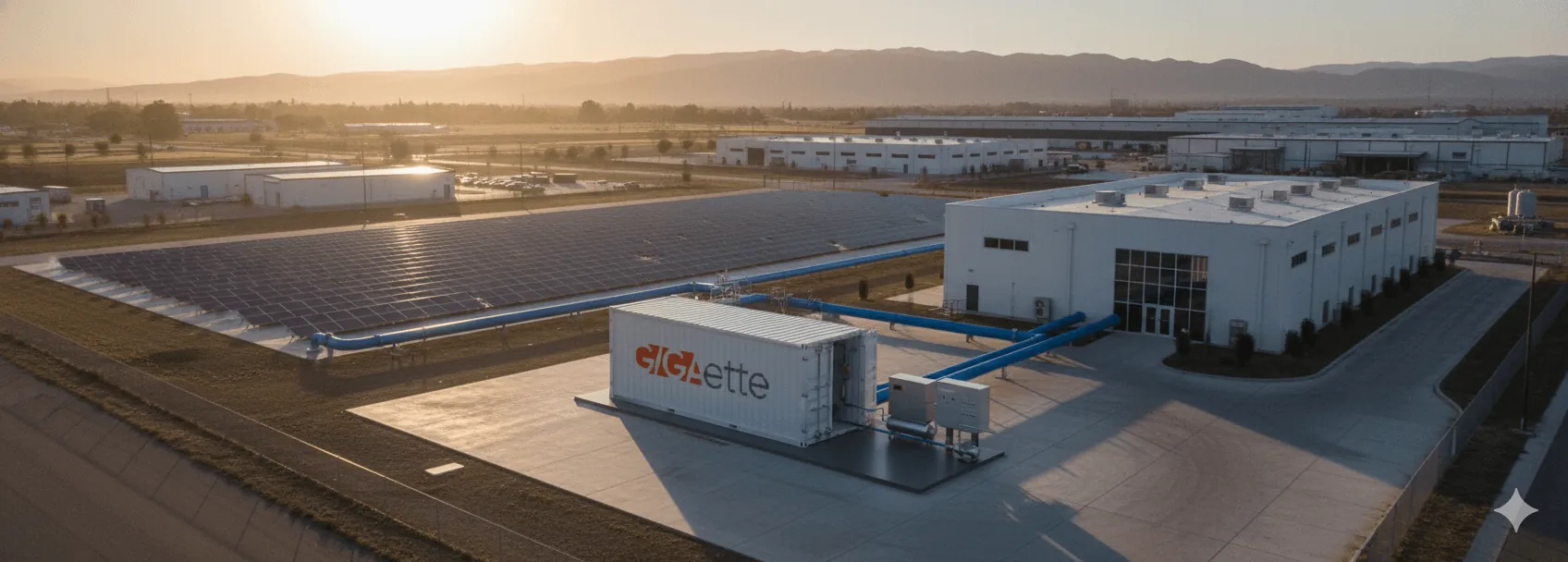
GIGAette’s IsoTES® targets exactly this problem: a single-tank system designed to deliver a constant output temperature across the full discharge.
Conclusion
A heat battery is not one technology but three approaches. Sensible storage is simple and cheap but slides in temperature. Latent storage holds the temperature at the cost of a more demanding material choice. Thermochemical storage has the most headroom and the least maturity.
Which one fits depends on the heat your process actually needs. If you would like to work through that question for your site, request a technical meeting.
For the fundamentals of thermal storage and its role in decarbonisation, see: